
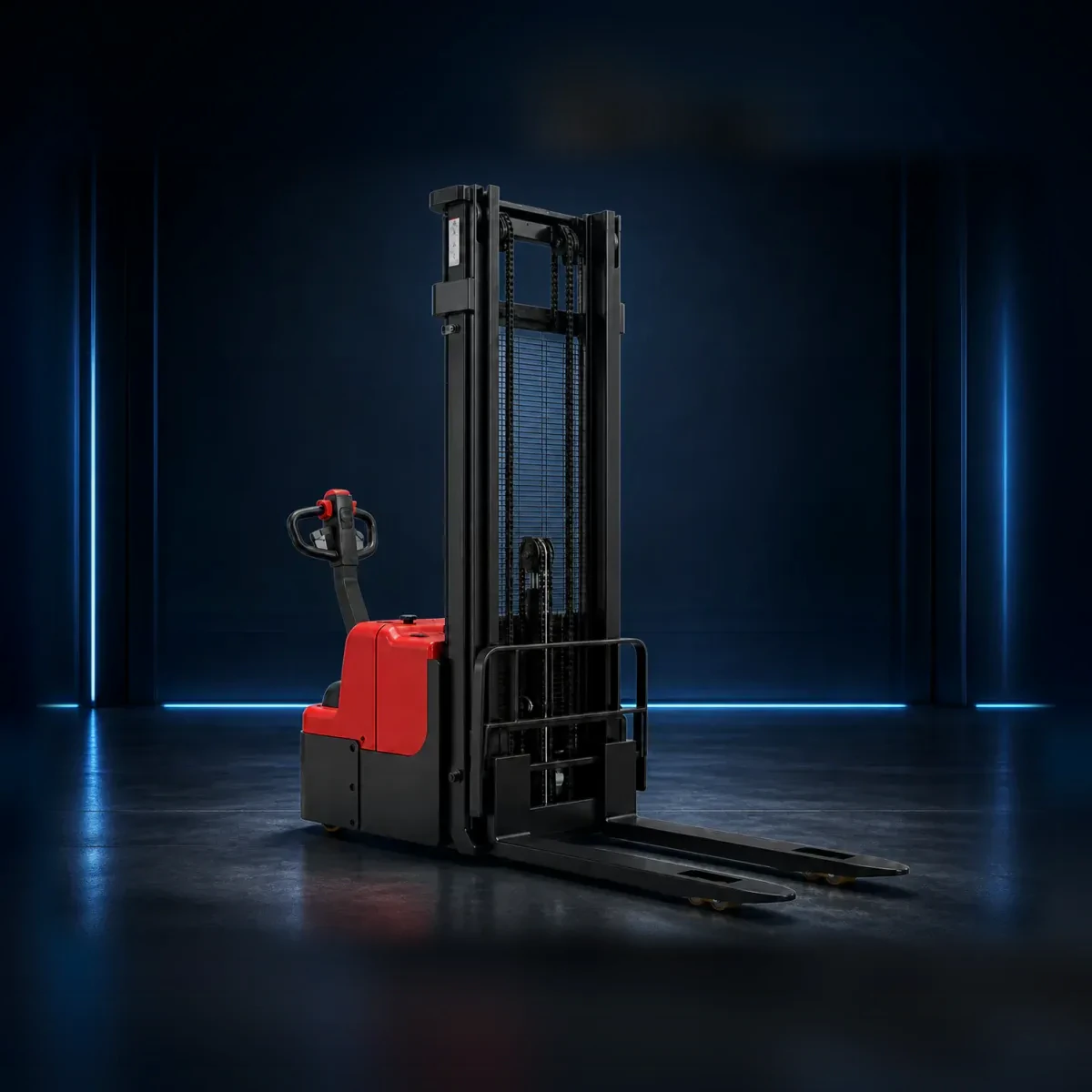
 1.5 t walk-behind configuration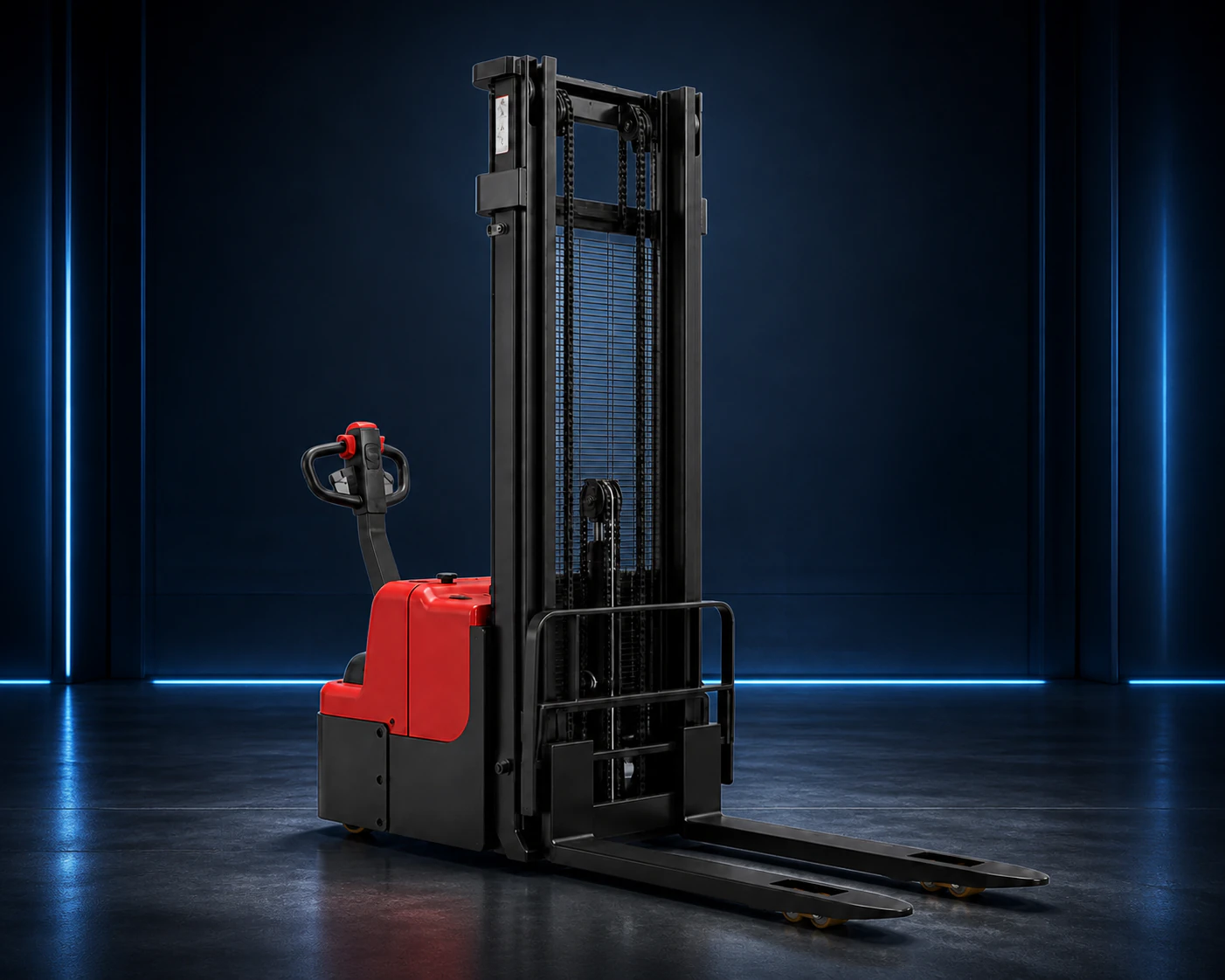
PALLET STACKER SELECTION
Electric Pallet Stacker Selection for Warehouses
Choose a walk-behind or ride-on configuration from pallet underside, residual capacity, lift height, aisle and travel demand—not capacity and height labels alone.
Pallet compatibility firstCheck bottom boards, entry direction, fork geometry and straddle-leg clearance.
Capacity at target heightRequest residual capacity for the exact mast and load centre.
Site-fit reviewCoordinate aisle, turning space, lowered mast height, floor and gradients.
One series, clear optionsPresent capacity and lift choices as configurations unless independent model evidence exists.
FEATURED STARTING POINTS
Start with stacker configurations that match the pallet base
Open a product page to compare available specifications, options and the questions needed for a useful quote.
1.5 t walk-behind configuration1 AVAILABLE PRODUCT OPTIONS
Compare the current powered stacker range
Compare the configurations that best match your load, layout, environment and order requirements.
Range imageElectric Pallet Stackers
1.5 Ton Electric Pallet Stacker
Priority 1,500 kg walk-behind stacker reference for narrow-aisle warehouse replenishment and distribution
COMPARE OPTIONS
Electric stacker configuration routes
Capacity and height are selection fields within a series until a supplier confirms an independent model, drawing and gallery.
| Configuration route | Pallet condition | Site decision |
|---|---|---|
| Fork-over walk-behind | Compatible open-bottom pallet | Short travel, clear floor, support-leg entry |
| Straddle walk-behind | Pallet fits between support legs | Straddle width, rack approach, load overhang |
| Counterbalanced | Closed-bottom or restricted pallet entry | Longer chassis, turning envelope, capacity at height |
| Ride-on | Compatible pallet and route | Travel distance, operator protection, aisle and duty |
Quotation status: Confirm for the selected model or project
QUOTE STARTING POINT
Four stacker inputs to send before asking for a price
The pallet and rack geometry can rule out a configuration before battery size or colour becomes relevant.
What are the pallet dimensions, entry direction and bottom-board arrangement?
Fork-over and straddle designs do not fit every closed-bottom pallet.
What is the highest fork level and required capacity at that height?
Residual capacity may differ from the rating stated near ground level.
What is the clear aisle, turning area and lowest doorway height?
Mast and chassis geometry must fit both travel and stacking paths.
How far, how often and on what floor will the stacker travel?
Travel distance and slopes influence walk-behind versus ride-on selection and energy demand.
FROM LISTING RANGE TO USABLE CONFIGURATION
A stacker sourcing process that starts under the pallet
WareVanta organises stacker enquiries around pallet construction, rack levels, residual capacity and the actual travel route. A supplier listing may combine several capacities and mast heights, but that does not prove every combination is a separately evidenced model. We request the configuration sheet, dimensional drawing and capacity-at-height data needed to compare offers on the same basis.
Pallet-entry review
Check whether forks, support legs and pallet underside can work together.
Rack interface
Map fork height, beam levels, lowered height and overhead restrictions.
Capacity evidence
Separate nominal capacity from the load allowed at the target lift.
Aisle fit
Review turning space and stacking aisle with the intended pallet.
Duty definition
Match walking or riding operation, travel distance and charging pattern.
Configuration control
Keep selectable heights and capacities within one series until model evidence supports separate pages.
RANGE STRUCTURE
Stacker layouts for different pallet-entry conditions
These are buyer decision paths, not claims that every option is available on every configuration.
Walk-behind fork-over stackers
A compact indoor route for compatible open-bottom pallets; confirm support-leg and bottom-board clearance.
Straddle stackers
Support legs pass outside the pallet; check pallet width, load overhang and rack approach.
Counterbalanced stackers
Useful where support legs cannot enter the pallet, with different chassis and aisle implications.
Ride-on stacker configurations
A starting point for longer travel duty; review platform, protection, aisle and local operating practice.
BUYING CRITERIA
The stacker details that prevent a poor pallet match
A usable configuration depends on the interface between pallet, fork, support legs, mast, rack and operator route.
Pallet underside
Record stringers, bottom boards, entry direction and fork openings before model selection.
Fork geometry
Confirm fork length, width, outside spread and adjustment against the pallet.
Support-leg clearance
Check whether fork-over or straddle legs can approach and enter the load.
Residual capacity
Request allowed load at the specified lift height and load centre.
Lowered mast height
Compare doorway and overhead clearance with the proposed mast fully lowered.
Stacking aisle
Verify the turning and approach envelope with the actual pallet length.
Travel duty
Use distance, slope, floor and frequency to choose walk-behind or ride-on operation.
Energy package
Match battery and charger information to daily duty and site power.
PALLET COMPATIBILITY
A stacker can meet the capacity and still fail at the pallet
Forks and support legs must physically enter or surround the selected pallet without hitting bottom boards, blocks or rack members. Send a pallet underside photo and dimensioned sketch, including entry direction and loaded overhang. The supplier should return fork dimensions, outside fork spread, support-leg geometry and a drawing of the proposed chassis. This check is often more decisive than the colour or nominal capacity in a product card.
Decision boundary
Final dimensions, load data, options, applicable documents and delivery terms are controlled by the approved quotation and project files.
APPLICATION PATHS
Where powered stackers suit the pallet route and rack
Application labels are starting points. Site conditions and project documents still govern the final selection.
Rack replenishment
Coordinate beam height, residual capacity, pallet entry and lowered mast height.
Pallet staging
Prioritise manoeuvrability, frequent short cycles and safe approach to staging positions.
Narrow-aisle handling
Verify the loaded stacking aisle and turning envelope rather than chassis width alone.
Longer internal travel
Review ride-on operation, floor condition, operator protection, battery duty and route traffic.
PROJECT COORDINATION
How pallet data becomes an approved stacker configuration
Map the pallet
Capture dimensions, underside, entry direction, load and overhang.
Map the rack
Record fork levels, beams, clearances, aisle and doorway restrictions.
Choose the chassis route
Compare fork-over, straddle, counterbalanced and ride-on approaches.
Confirm capacity at height
Request a model-specific residual-capacity statement and dimensional drawing.
Review energy and operation
Match travel, shifts, slopes, battery, charger and operator mode.
Close order evidence
Approve the model sheet, manuals, parts scope, inspection and packing plan.
EVIDENCE & RESOURCES
Evidence that confirms pallet fit and residual capacity
We do not present category imagery as proof of stock, factory ownership, certification or a completed customer project.
- Pallet underside: What are the pallet dimensions, entry direction and bottom-board arrangement?
- Rack and lift: What is the highest fork level and required capacity at that height?
- Aisle and overhead: What is the clear aisle, turning area and lowest doorway height?
- Travel duty: How far, how often and on what floor will the stacker travel?
Request a model- or project-specific specification that identifies the exact configuration, governing dimensions and performance fields. A category page is not a substitute for that record.
- Approved specification or project drawing
- Applicable inspection checklist
- Packing list and loading plan
- Manuals and parts information where applicable
- Destination-specific compliance documents only after scope confirmation
- Pallet dimensions and underside
- Maximum load and load centre
- Required fork height
- Required capacity at height
- Lowest doorway or overhead
- Clear aisle and turning area
- Travel distance, floor and slopes
- Moves, hours and shifts per day
- Charging power supply
BUYER RESOURCES
View all resources →Selection resources for stacker and narrow-aisle buyers
Forklift Quote Request Template: Parameters Buyers Must Ask
Prepare a comparable forklift quote request with operating data, technical configuration, commercial scope and unit-specific evidence.
Read the guide →Electric Forklift Buying Guide for Importers and Warehouse Buyers
A practical framework for comparing capacity, load center, mast, battery, aisle width and supplier evidence.
Read the guide →China Equipment Supplier Qualification Checklist
A practical due-diligence workflow for legal identity, manufacturing role, product fit, quality evidence, payment and contract controls.
Read the guide →Downloads: model sheets, drawings, conformity files, inspection records and packing documents are supplied only when they apply to the selected configuration and have been approved for release.
CONFIGURATION BEFORE PRICE
Turn pallet and rack data into a comparable electric pallet stacker offer.
Send the operating data once. We will identify the gaps that prevent a fair comparison.
WhatsApp the requirementBUYER DECISION SCENARIOS
What stacker buyers usually need to resolve
Representative procurement situations used to structure an RFQ; no customer identity or project result is implied.
Closed-bottom pallet
The priority is pallet-entry geometry and a choice between straddle or counterbalanced routes.
High rack with a low doorway
The priority is to reconcile fork height, residual capacity and lowered mast height.
Long travel between zones
The priority is operator mode, route safety, energy package and turning space—not lift height alone.
DIRECT ANSWERS
Questions to answer before requesting an electric pallet stacker quote
Answers are written for early procurement decisions. Project-specific facts still require the approved quotation and documents.
What is the difference between a pallet stacker and a forklift?
A stacker normally uses a compact pedestrian or ride-on chassis for pallet movement and rack replenishment, while a counterbalance forklift carries the load ahead of the front axle without support legs around the pallet. The correct choice depends on pallet underside, travel distance, lift height, aisle, floor and required capacity at height—not the name alone.
Will an electric stacker work with every pallet?
No. Fork-over support legs require suitable openings beneath the pallet, while straddle legs require enough width outside it. Closed-bottom pallets, stringers, blocks and loaded overhang can prevent entry. Send dimensions and an underside photo, then confirm fork and support-leg geometry on the proposed model drawing before quotation approval.
Why must residual capacity be checked for a stacker?
The rated capacity may be stated at a particular load centre and lower lift condition. Available capacity can change as lift height increases or load geometry differs. Request a residual-capacity chart or written capacity value for the exact mast, lift height, load centre and pallet arrangement. Do not assume a title-level rating applies at every rack level.
How should lift height be specified?
State the required fork elevation at the highest placement point, not only the rack or ceiling height. Also provide beam levels, pallet height, lowest doorway and overhead clearance. The supplier response should identify maximum fork height, mast stages, free lift if applicable, lowered mast height and capacity at the requested elevation.
When is a ride-on electric stacker more suitable than walk-behind?
Ride-on operation may be considered when routes are longer or travel frequency is high, but it changes chassis length, turning space, operator protection and cost. Provide route distance, cycle frequency, aisle, floor, gradients and traffic conditions. Compare the complete operating envelope rather than choosing from travel speed or platform appearance alone.
What aisle measurement does a stacker supplier need?
Provide the narrowest clear aisle, rack face to obstruction, pallet length in the travel direction, turning areas and any columns, guards or doors. Ask for the stated stacking aisle for the exact load and chassis. Overall machine width or turning radius alone does not prove that the loaded stacker can enter and place the pallet.
Which stacker specifications should appear in a quotation?
Include rated and residual capacity, load centre, maximum fork height, mast type, lowered height, fork dimensions and spread, support-leg geometry, chassis dimensions, turning and aisle data, battery, charger input, travel and lift system, wheels, brakes, documents, warranty boundaries, packing and commercial terms. Mark all model-dependent fields that remain open.
Can one supplier listing support several stacker product pages?
Only when each page represents an independently evidenced model with its own title identity, specifications, image set and buying task. A listing that exposes capacity and lift choices should normally be presented as a series or configuration matrix. Creating a separate page for every combination without independent evidence can confuse buyers and duplicate search intent.
1. Begin with the pallet underside
Record pallet length, width, height, entry direction, fork openings, stringers, blocks and bottom boards. Add the loaded weight, centre of gravity and any overhang. A top-view dimension alone is not sufficient because support legs and forks approach the underside. Photographs from the entry direction and below the pallet are especially useful when the pallet is not a standard open-bottom design.
Ask the supplier to return fork length, width, thickness, outside spread, support-leg dimensions and clearances on a model drawing. This establishes whether a fork-over, straddle or counterbalanced configuration can physically engage the pallet before price comparison begins.
2. Select the chassis route before the lift height
Fork-over walk-behind stackers can be compact where support legs may enter beneath a compatible pallet. Straddle stackers place the support legs outside the pallet and require suitable outside width and rack approach. Counterbalanced stackers avoid front support legs but create a different chassis length, counterweight and turning envelope. Ride-on configurations may suit longer travel but also require operator-space and route review.
Treat these as selection routes, not universal claims about the listed products. The supplier must confirm which chassis is available for the required load, mast and destination, with a drawing that shows the relevant geometry.
3. Define the real placement height
Measure the required fork height at the highest placement point, the beam levels, pallet height and the lowest overhead restriction along the route. If the stacker must pass a doorway or work under a low ceiling, include that clear height. The mast must both reach the rack and collapse sufficiently for travel.
The quotation should identify mast stages, maximum fork elevation, free lift where relevant, lowered mast height and overall raised height. These fields should come from the exact configuration sheet rather than a combined listing range that includes several mast options.
4. Verify residual capacity at the requested height
Nominal capacity does not automatically apply at every fork height and load centre. As the mast rises, the permitted load may reduce. Load shape, pallet depth and any forward offset can further affect the calculation. State the required load at the highest level, not only the heaviest load handled near the floor.
Request a model-specific residual-capacity chart or written value tied to the mast, fork height and load centre. If the supplier cannot establish that relationship, leave the field open and do not present the configuration as approved.
5. Measure the loaded route
Provide clear aisle width, rack face, pallet length, turning space, doorway width, floor transitions, gradients and traffic interfaces. For right-angle stacking, the working envelope includes the chassis, forks and load. Overall width and turning radius can help, but neither alone proves the pallet can be placed in the available aisle.
Describe floor smoothness, joints, thresholds, drainage, debris and ramps. Small wheels and low-clearance support legs may react differently to floor defects. Ask the supplier to state the permitted slope and surface assumptions for the proposed configuration.
6. Match operator mode and energy to travel demand
Estimate route length, moves per hour, lifting frequency, hours per shift and shifts per day. Walk-behind operation may suit shorter controlled routes, while longer travel can justify reviewing a platform or ride-on design. The decision also depends on congestion, visibility, operator protection and local practice.
Supply the site's voltage, phase, frequency and charging windows. Compare battery chemistry, voltage, capacity, charger input, connector, warranty boundaries and replacement route. Avoid choosing from an unspecified battery label or a charging-time claim without the duty assumptions behind it.
7. Normalise the technical and document package
Use one response sheet for every candidate. Include capacity, load centre, residual capacity, lift and lowered heights, mast, fork and support-leg geometry, chassis dimensions, stacking aisle, travel and lift systems, battery, charger, wheels, brake and controls. Ask each supplier to mark deviations and unsupported fields clearly.
Request the exact datasheet, drawing, capacity information, operating manual, parts information and applicable compliance documents. Match model names and document scope. A supplier-profile image or generic declaration should not be treated as evidence for an unconfirmed stacker configuration.
8. Approve the complete order scope
Confirm whether forks, charger, battery, optional platform, spare parts, manuals, packing and requested inspection are included. Obtain packed dimensions and weights for freight planning. Define the inspection around identity, nameplates, fork/support-leg dimensions, mast function, controls, brakes, charger, accessories and packing protection.
State warranty coverage, exclusions, claim evidence, replacement-part freight and local labour responsibility. Then tie the approved specification and commercial scope to the quotation and order documents so a selectable listing range does not become an ambiguous delivered configuration.
9. Confirm safe handover information
Agree which operating, charging, inspection and maintenance information will accompany the machine. The exact manual and parts information should match the delivered model and language requirement. Identify any assembly, commissioning or local training responsibility without implying that a remote supplier automatically covers site services.
At receipt, compare model, serial, battery, charger, fork and support-leg dimensions with the order record. Photograph discrepancies before use and route technical changes through the same approval process used during quotation.
10. Use operating evidence to improve the next selection
Once commissioned, record pallet compatibility, aisle fit, actual route length, charge pattern and capacity at the intended levels. These internal operating observations reveal whether the original duty statement was accurate and which inputs deserve tighter control on future enquiries.
Keep service events and replacement-part identity with the model record. A disciplined handover reduces dependence on headline specifications when operators later need manuals, wheels, batteries, controls or mast components.
STRUCTURED RFQ
Send pallet and rack data so electric pallet stacker offers can be compared
Include the fields below in the application message. If a field is unknown, say so and we will identify the next measurement or document required.
- 01Pallet dimensions and underside *
- 02Maximum load and load centre *
- 03Required fork height *
- 04Required capacity at height *
- 05Lowest doorway or overhead
- 06Clear aisle and turning area *
- 07Travel distance, floor and slopes
- 08Moves, hours and shifts per day
- 09Charging power supply